Portion control without counting calories is entirely possible, and for many people, far more sustainable than tracking every number. Harvard T.H. Chan School of Public Health developed the Healthy Eating Plate specifically as a visual tool, so people could build balanced meals by proportion rather than precise measurement. You don’t need an app open at every meal to eat well.
This article covers the plate method, the palm method, and other simple visual tricks that make portion awareness automatic, wherever you’re eating.
For more on building balanced meals in advance, read our guide on Meal Prepping for Busy Professionals: A Beginner’s Guide.
Portion Control Without Counting Calories: The Plate Method
The Harvard Healthy Eating Plate divides your plate into simple visual proportions, without requiring you to measure or track anything. The framework breaks down as follows:
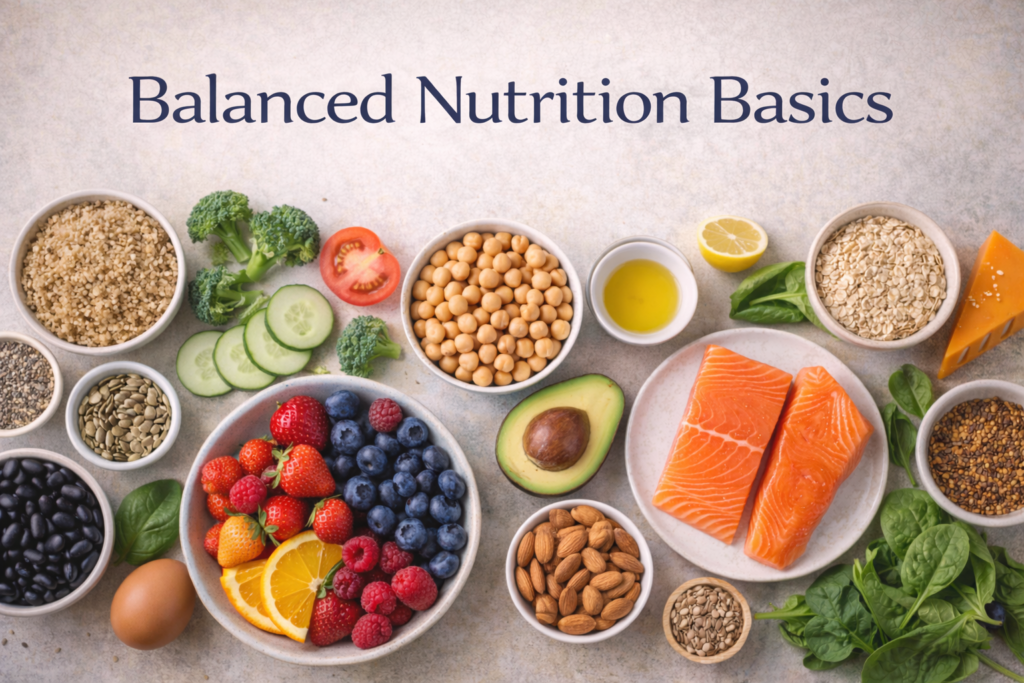
- Half the plate: vegetables and fruits, with an emphasis on vegetables and a wide variety of colours. Potatoes don’t count in this category, since they affect blood sugar more like a refined starch.
- A quarter of the plate: whole grains, such as brown rice, oats, quinoa, or whole wheat bread.
- A quarter of the plate: healthy protein, such as fish, poultry, beans, eggs, or tofu.
- Healthy oils, in moderation: olive oil and other plant oils used for cooking or dressing, rather than butter or heavily processed fats.
Research on people following Harvard Plate guidelines consistently shows higher intakes of fruits, vegetables, and whole grains, alongside lower intakes of unhealthy fats and added sugar, compared with less structured eating patterns.
The Palm Method: An Alternative for Precision Without Measuring
For people who want a bit more precision without weighing food or counting calories, the palm method offers a simple, body-based reference that travels with you everywhere.
- Protein: a portion roughly the size and thickness of your palm.
- Vegetables: a fist-sized portion, or more if you’d like.
- Grains or starches: a cupped handful.
- Fats: roughly a thumb-sized portion.
This method works well because it scales naturally to your own body size, and it works in any setting, from a restaurant to a friend’s dinner table, without needing to see the actual plate size or serving dish first.
Read more on how sustainable morning routine tends to share a few specific qualities.
Why Plate Size Matters More Than People Expect
One genuine limitation of the plate method is worth knowing. A quarter-plate portion on a small 28cm plate is meaningfully different from a quarter-plate portion on a large 38cm plate. Since plate sizes have grown significantly over recent decades, this can quietly undermine the method if you’re using an oversized plate without realising it.
A simple fix: use a smaller plate as your default, roughly dinner-plate sized rather than a large platter. This alone tends to reduce portion sizes naturally, without needing to think about it at every meal.
Applying Portion Control Without Counting Calories to Real Meals
These principles work across almost any cuisine or meal structure. A few practical examples:
- Breakfast: a bowl of oats topped with berries and a spoonful of nut butter, roughly following the same proportions in a smaller format.
- Lunch: a large mixed salad with roasted vegetables, a portion of grilled chicken or chickpeas, and a scoop of quinoa or brown rice.
- Dinner: half the plate filled with roasted vegetables, a quarter with baked salmon, and a quarter with a whole grain like farro or wild rice.
- Snacks: the same proportional thinking applies in miniature — pairing a protein or fat source with something fibre-rich, rather than eating a single food group alone.
Our guide on Healthy Snacking Without Constant Hunger covers this same proportional thinking applied specifically to snacks.
Other Simple Visual Cues Worth Knowing
- Serve food onto a plate rather than eating from the package: eating straight from a bag or box makes portions far easier to lose track of, regardless of how mindful you’re trying to be.
- Check labels occasionally, without obsessing: glancing at a serving size on unfamiliar packaged foods now and then helps calibrate your visual sense over time.
- Let hunger and fullness guide the pace: eating slowly enough to notice genuine fullness cues works alongside visual portion methods, rather than replacing them.
The Harvard Healthy Eating Plate guide offers further detail on the framework, including translated versions and specific meal examples.
Key Takeaways
- Portion control without counting calories is achievable using simple visual tools like the Harvard Healthy Eating Plate.
- The plate method divides meals into roughly half vegetables and fruit, a quarter whole grains, and a quarter healthy protein.
- The palm method offers a body-based alternative that works well when you’re away from a plate entirely, such as at a buffet or restaurant.
- Plate size affects how well the plate method works — a smaller plate naturally supports better portion awareness.
- These principles apply across cuisines and even to snacks, not just full meals.
Final Thoughts
Portion control without counting calories works because it builds a mental model rather than a set of rules to track. Once you genuinely understand what a balanced plate looks like, you can apply it anywhere — at a restaurant, at a family dinner, while travelling — without needing an app open at every meal.
Start with just one meal a day. Build it using the plate method, notice how it feels, and let the pattern become intuitive from there. No tracking required — just a plate and a bit of attention.
Balance the plate. Let the proportions do the work.
Medical Disclaimer: The information on this page is provided for educational and informational purposes only and is not intended as medical advice. It should not replace consultation with a qualified healthcare professional. For full details, please read our Disclaimer.