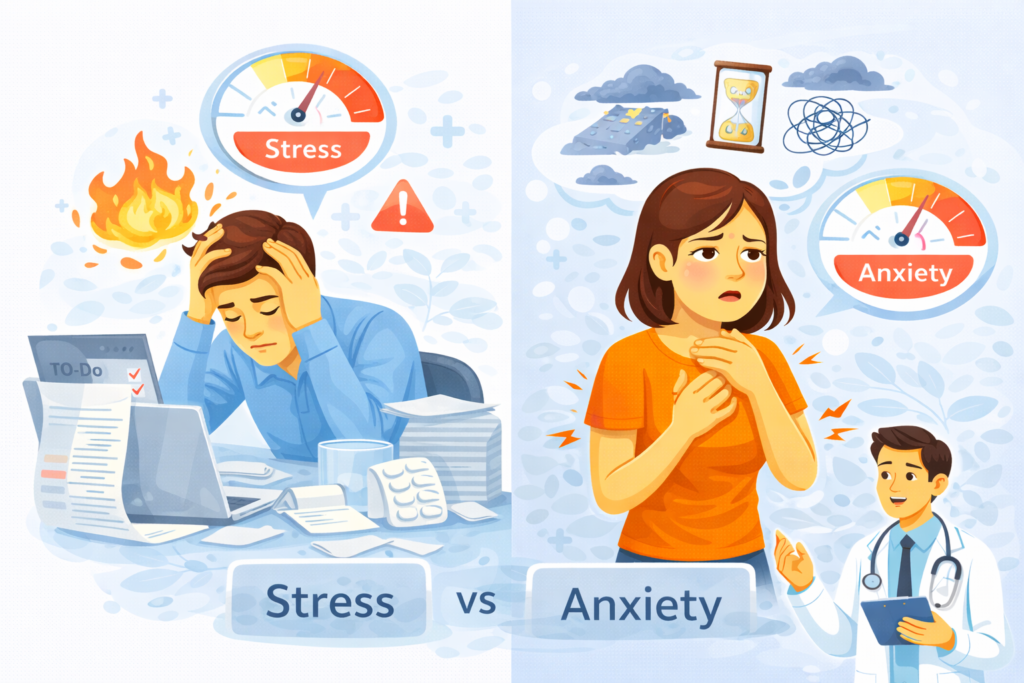
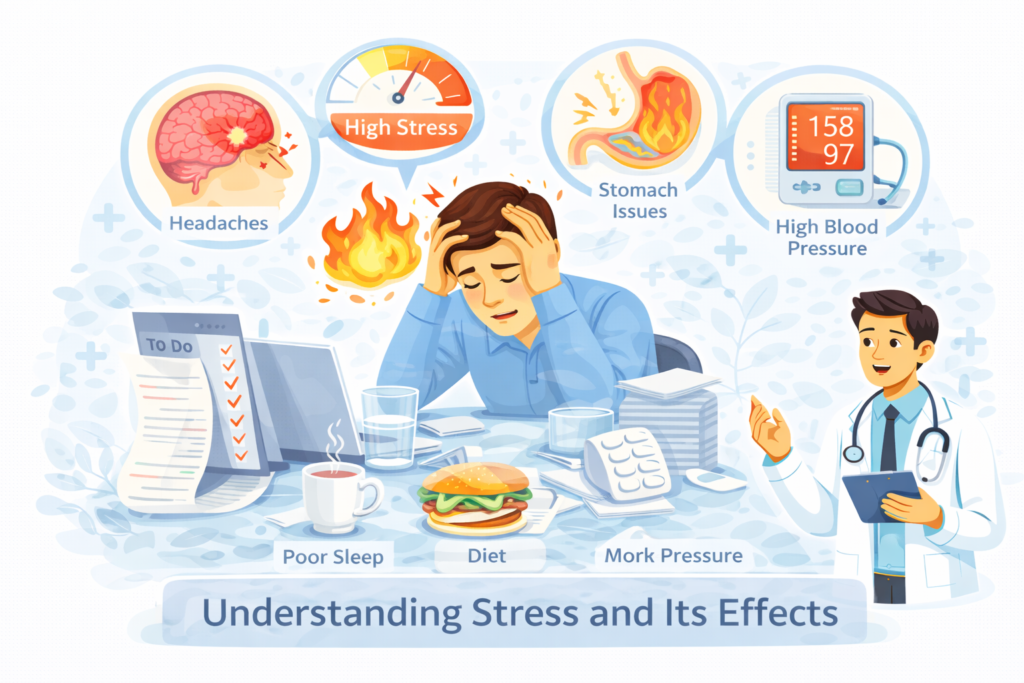
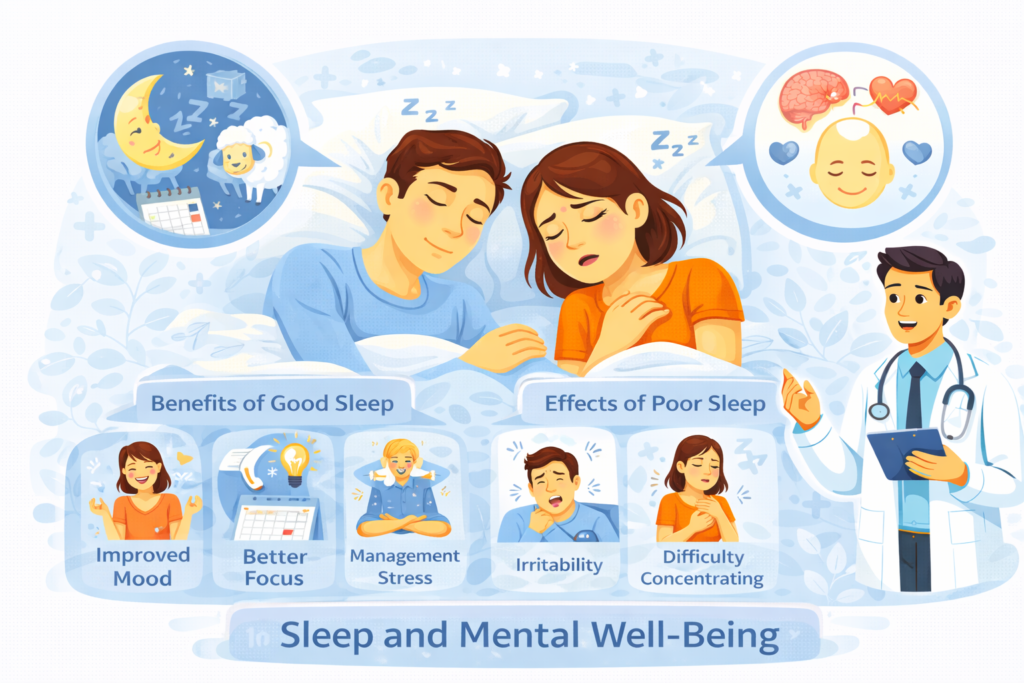
An overactive mind before bed is one of the most common sleep complaints among adults. You are physically exhausted. The room is dark and quiet. Your body wants to sleep. Yet the moment your head hits the pillow, your brain shifts into high gear — replaying conversations, drafting tomorrow’s to-do list, rehearsing worries, and running through scenarios that feel completely uncontrollable. The silence that should signal rest instead signals your mind to start working.
Sleep specialist Dr Michael Breus describes the clinical term for this as rumination — the overactivation of the brain’s frontal cortex that produces racing thoughts. It is almost always driven by anxiety. It is also one of the most significant drivers of insomnia. A 2025 large-scale study by Zheng and colleagues, following nearly 5,000 participants, found that irregular sleep schedules and nighttime anxiety are closely and bidirectionally linked — poor sleep worsens anxiety, and anxiety worsens sleep, in a cycle that can sustain itself indefinitely without intervention.
This article explains exactly why the overactive mind kicks in at night, what the science says about how to stop it, and which techniques are most effective — backed by current sleep medicine and psychology research.
To understand the broader types of rest your mind and nervous system need beyond sleep, read our article on The 6 Types of Rest You Need Beyond Sleep.
Why an Overactive Mind Before Bed Happens
Understanding why the overactive mind before bed occurs helps you address the cause rather than just manage the symptom. Several factors explain why the brain shifts into rumination mode precisely when you want it to wind down.
Daytime stress accumulates and catches up at night
Throughout the day, activity, tasks, and social engagement occupy your conscious attention. Stress and unresolved emotional material sit in the background. When the day ends and those distractions fall away, the brain finally has space to process everything it has been holding. The quiet that feels like it should produce rest instead becomes an opening for everything you did not have time to think about during the day.
The brain has no off switch
The brain does not shut down at night — it transitions between states of alertness and rest. That transition requires the nervous system to shift from the sympathetic fight-or-flight state, which drives daytime alertness, to the parasympathetic rest-and-digest state that enables sleep onset. When stress hormones — particularly cortisol and adrenaline — remain elevated, the nervous system stays locked in sympathetic mode. The brain keeps firing because biologically it believes you are still in a situation requiring vigilance.
Screens and stimulation delay the transition
Bright screens suppress melatonin production. They also expose the brain to emotionally stimulating content — news, social media, videos — that activates rather than calms the nervous system. Using screens until the moment you try to sleep removes the transition period the brain needs to shift out of alert mode. Research consistently identifies screen use close to bedtime as a primary driver of nighttime mental overactivity.
Anxiety about not sleeping creates a second layer
One of the most insidious features of an overactive mind before bed is what sleep researchers call sleep performance anxiety. As soon as falling asleep becomes something you are trying to force, the effort itself creates arousal. Watching the clock, calculating how many hours of sleep remain, and catastrophising about tomorrow’s functioning all amplify the very alertness you are trying to reduce. Sleep specialist Rob Newsom from the Sleep Foundation notes that when people stop forcing sleep, their anxiety drops and real rest comes naturally — a principle that is easier to understand than to apply, but that forms the basis of the most effective treatment for insomnia.
Why an Overactive Mind Before Bed Worsens Without Intervention
An overactive mind before bed does not typically resolve on its own over time. Several mechanisms cause the problem to intensify without deliberate intervention.
The bed becomes associated with wakefulness
When you spend significant time lying awake in bed — whether scrolling a phone, watching television, or simply lying there with racing thoughts — your brain develops a learned association between the bed and wakefulness. The bed, which should trigger drowsiness, begins to trigger alertness instead. Sleep psychologist Michelle Drerup notes that limiting time in bed to actual sleep is critical for preventing and reversing this association. This is one of the core principles of Cognitive Behavioural Therapy for Insomnia — CBT-I — the gold standard non-drug treatment for chronic insomnia.
Sleep deprivation worsens anxiety
Poor sleep directly increases anxiety the following day. The prefrontal cortex — which regulates emotional responses and rational thinking — functions less effectively when under-slept. The amygdala, which generates threat responses and anxiety, becomes overreactive. The result is that one bad night makes the following night harder to settle, which creates more sleep deprivation, which generates more anxiety — a self-sustaining cycle.
Irregular sleep schedules amplify nighttime anxiety
The 2025 study by Zheng and colleagues specifically found that irregular sleep schedules raise anxiety and worsen nighttime mental overactivity. Consistent sleep and wake times — even at weekends — strengthen the circadian rhythm and support the natural transition to sleep at the appropriate time. Variable schedules disrupt this rhythm and make the brain’s transition to sleep less reliable.
How to Calm an Overactive Mind Before Bed: What the Science Supports
The following techniques have the strongest evidence base for calming an overactive mind before bed. Each addresses a different aspect of nighttime mental overactivity — and combining two or three produces significantly better results than using any single technique alone.
1. The pre-bed brain dump
A brain dump is a simple but highly effective technique for clearing mental clutter before sleep. Spend five to ten minutes writing down everything currently occupying your mind — tasks, worries, unresolved thoughts, things you are afraid of forgetting. The act of externalising these thoughts onto paper signals to the brain that they have been acknowledged and recorded. They no longer need to stay active in working memory to avoid being forgotten.
Research in cognitive behavioural therapy for insomnia supports the use of pre-bed writing for reducing nighttime rumination. A specific version — writing a to-do list for tomorrow rather than a general worry dump — has been shown in research from Baylor University to help people fall asleep significantly faster. Participants who spent five minutes writing a specific, concrete to-do list fell asleep nine minutes faster than those who wrote about completed tasks. Nine minutes may sound modest — but for someone who routinely lies awake for thirty to sixty minutes, it is meaningful.
2. Cognitive shuffling
Cognitive shuffling is a technique developed by cognitive scientist Dr Luc Beaulieu-Prévost. Rather than trying to stop thinking — which rarely works and often backfires — you deliberately redirect your mind to a random sequence of neutral, unconnected mental images. Think of a completely random word. Visualise it clearly. Then move immediately to another unrelated image, then another, with no narrative connecting them.
The technique works by occupying the parts of working memory that would otherwise be filled with emotionally charged ruminative content. Research in cognitive behavioural therapy for insomnia confirms that neutral mental imagery reduces mental arousal and helps the brain shift into sleep mode more effectively than attempts to suppress thoughts directly. It is particularly effective because it gives the racing mind something to do — just nothing worth staying alert for.
3. Controlled breathing — particularly 4-7-8 breathing
Controlled breathing is one of the most direct and immediate ways to shift the nervous system from sympathetic to parasympathetic mode. The exhale is particularly important — a longer exhale than inhale activates the vagus nerve, which drives parasympathetic activation and reduces heart rate and cortisol.
The 4-7-8 technique involves inhaling for four counts, holding for seven counts, and exhaling for eight counts. A 2025 study by Steinmane and Fernate confirmed that this breathing pattern calms the nervous system and lowers heart rate before bed. It is simple, requires no equipment, and can be used lying in bed without disturbing a partner.
An alternative — box breathing — involves inhaling for four counts, holding for four, exhaling for four, and holding for four. Both techniques produce measurable reductions in physiological arousal within minutes of starting. Starting with just four breath cycles before sleep is sufficient to notice a calming effect.
4. A consistent wind-down routine
The 2025 study by Zheng and colleagues confirmed that consistent bedtime routines lower anxiety and improve sleep quality over time. A wind-down routine works because it provides the brain with a reliable sequence of signals that sleep is approaching — allowing the nervous system to begin its shift toward rest before you even get into bed.
An effective wind-down routine for an overactive mind before bed might include:
- dimming lights one hour before bed — bright light suppresses melatonin production and keeps the brain in alert mode
- stopping work-related tasks and avoiding difficult conversations in the final hour before sleep
- doing the brain dump or to-do list writing in the early evening rather than immediately before sleep
- choosing something repetitive and low-effort — gentle stretching, light reading, a puzzle, or folding laundry — rather than something emotionally stimulating
- avoiding screens for at least 30 to 60 minutes before bed — this is supported by Cleveland Clinic sleep experts and consistent across sleep medicine guidance
The goal is to give the brain what sleep specialists describe as a runway to land — a gradual deceleration rather than expecting it to switch from full speed to sleep in seconds.
5. The body scan
A body scan involves deliberately moving your attention through different parts of the body in sequence — feet, calves, knees, thighs, and upward — noticing physical sensations without trying to change them. It shifts attention away from cognitive content — thoughts, worries, plans — toward physical sensation, which is fundamentally less arousing than thought-based rumination.
The National Sleep Foundation recommends yoga nidra — a guided version of body scan practice — for reducing racing thoughts and improving sleep onset speed. The technique works through two mechanisms: it directs attention away from ruminative content, and it progressively releases physical tension that maintains physiological arousal.
6. Get out of bed if sleep does not come
If you have been lying awake for fifteen to twenty minutes without sleep approaching, get out of bed. This is one of the core recommendations of CBT-I and is consistently supported by sleep medicine research. Lying in bed awake for extended periods strengthens the learned association between the bed and wakefulness.
Move to another room and do something calm and low-stimulation — read a physical book, listen to a quiet podcast, do a puzzle — until you feel genuinely sleepy. Then return to bed. This feels counterintuitive. In practice, it is one of the most reliably effective techniques for breaking the cycle of nighttime mental overactivity.
7. Paradoxical intention
Paradoxical intention involves deliberately trying to stay awake while lying in bed with the lights off, rather than trying to fall asleep. Research published in BMJ Journals by Salim and colleagues in 2024 confirmed that paradoxical intention reduces sleep performance anxiety and improves sleep onset. By removing the pressure to sleep, it eliminates the anxiety that effort creates. The brain, no longer fighting against itself, naturally transitions toward sleep without the performance anxiety that was preventing it.
8. Supplements with evidence behind them
For mild cases of nighttime mental overactivity, two supplements have the most consistent evidence base. Magnesium glycinate supports GABA regulation — the brain’s primary calming neurotransmitter — and promotes muscle relaxation and nervous system calming before sleep. L-theanine, an amino acid found naturally in green tea, reduces physiological stress responses and promotes calm without sedation. CNN health reporting in 2025 cites both as commonly recommended by experts for mild nighttime anxiety. Neither is a substitute for the behavioural techniques above — but both can complement them, particularly when stress and anxiety are high.
When an Overactive Mind Before Bed Requires Professional Support
The strategies in this article are effective for the majority of people dealing with occasional or moderate nighttime mental overactivity. However, persistent racing thoughts that significantly disrupt sleep — particularly those accompanied by other symptoms — may require professional support.
Consider speaking with a GP or mental health professional if:
- you have used the techniques above consistently for three to four weeks with little improvement
- your nighttime thoughts are significantly distressing, intrusive, or feel outside your control
- racing thoughts at night are accompanied by persistent low mood, anxiety throughout the day, or significant fatigue affecting daily functioning
- you are sleeping fewer than five hours per night consistently
- nighttime mental overactivity is linked to trauma, grief, or a significant life event
CBT-I — Cognitive Behavioural Therapy for Insomnia — is the gold standard, first-line treatment for chronic insomnia and nighttime anxiety. It is more effective than sleep medication for long-term outcomes and produces no dependency or side effects. Ask your GP for a referral or access it through an accredited digital CBT-I programme.
For more on how anxiety and mental load connect to exhaustion and wellbeing, read our article on High-Functioning Anxiety: Why You Look Fine But Feel Drowning.
The NHS Every Mind Matters sleep guide provides practical, evidence-based advice on improving sleep and managing nighttime anxiety — including access to free sleep improvement resources.
Key Takeaways
- An overactive mind before bed is driven by the nervous system staying locked in sympathetic fight-or-flight mode rather than transitioning to the parasympathetic rest state that enables sleep.
- A 2025 large-scale study confirmed that irregular sleep schedules and nighttime anxiety are bidirectionally linked — poor sleep worsens anxiety and anxiety worsens sleep, sustaining a cycle that requires deliberate intervention to break.
- The pre-bed brain dump — spending five to ten minutes writing down tasks and worries — reduces nighttime rumination by externalising mental content so the brain no longer needs to keep it active in working memory.
- Cognitive shuffling — deliberately redirecting the mind to neutral, unconnected mental images — occupies working memory with non-arousing content and helps the brain transition toward sleep more effectively than attempting to suppress thoughts.
- The 4-7-8 breathing technique, confirmed in a 2025 study to calm the nervous system and lower heart rate before bed, shifts the body from sympathetic to parasympathetic mode within minutes.
- Getting out of bed after fifteen to twenty minutes of wakefulness — rather than lying awake — prevents the bed from becoming associated with wakefulness and is one of the most effective CBT-I techniques available.
- CBT-I is the gold standard first-line treatment for persistent nighttime mental overactivity and insomnia — more effective than sleep medication for long-term outcomes and available through GP referral or accredited digital programmes.
Final Thoughts
An overactive mind before bed is not a sign that something is fundamentally wrong with you. It is a sign that your nervous system has not yet received a clear enough signal that the day is over and it is safe to rest. The brain is doing exactly what it is designed to do — monitoring, processing, and preparing. It simply needs more deliberate guidance to stop.
Start with one technique tonight. The brain dump takes five minutes. The 4-7-8 breathing takes two. The wind-down routine starts with dimming the lights one hour before bed. None of these require significant time or effort. What they require is consistency — because the nervous system responds to repeated signals, not single attempts.
Give your brain the runway it needs. The landing becomes easier every time you practice.
Medical Disclaimer: The information on this page is provided for educational and informational purposes only and is not intended as medical advice. It should not replace consultation with a qualified healthcare professional. For full details, please read our Disclaimer.