From the outside, everything looks fine. You meet your deadlines. You show up on time. You remember everyone’s birthdays, hold down a job, maintain your relationships, and keep your life running smoothly.
But on the inside, it is a different story. Your mind races before you fall asleep. You replay conversations for days. You say yes to things you cannot afford to take on because saying no feels unbearable. You prepare obsessively for situations that most people handle without a second thought.
This is high-functioning anxiety — and millions of people live with it without ever recognising it for what it is.
Because you appear capable and composed to everyone around you, it is easy to dismiss what you are feeling as personality traits rather than a mental health condition worth addressing. This article explains what high-functioning anxiety actually is, why it is so easy to miss, and what genuinely helps.
What high-functioning anxiety is
It is important to note that high-functioning anxiety is not a formal clinical diagnosis listed in medical classification systems. It does not appear as a named condition in the DSM-5 or ICD-11, the standard references doctors use to diagnose mental health conditions.
What it describes, however, is a very real experience: anxiety that is significant enough to cause internal distress and physical symptoms, but that the person manages well enough externally to appear capable, successful, and in control.
Most people with high-functioning anxiety meet the criteria for Generalised Anxiety Disorder, social anxiety disorder, or another recognised anxiety condition — they simply do not present in the way many people expect anxiety to look. They are not visibly falling apart. They are, in fact, often over-performing.
The anxiety does not make them less productive. In many cases, it drives their productivity. The relentless need to prepare, over-deliver, and avoid failure becomes the engine behind their achievements — at a significant internal cost.
Signs of high-functioning anxiety
Because high-functioning anxiety often looks like conscientiousness or drive from the outside, its signs are easy to attribute to personality rather than an anxiety condition.
Signs others see
- consistently punctual, often arriving early to avoid the anxiety of being late
- highly organised and detail-oriented, sometimes excessively so
- described by others as reliable, capable, and on top of everything
- rarely says no, even when already overwhelmed
- appears calm and composed in stressful situations
- high achiever at work or in studies
- frequently checks in on others and manages situations preemptively
Signs only you know about
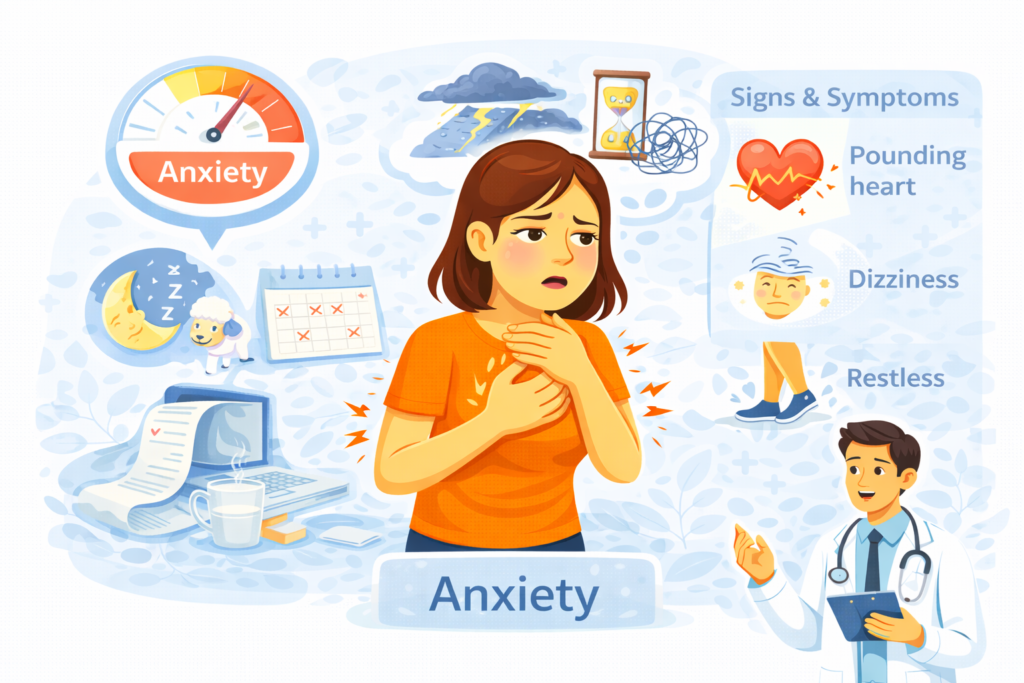
- a mind that rarely stops — replaying past conversations, rehearsing future ones, and analysing everything in between
- difficulty falling or staying asleep because thoughts keep arriving
- a persistent low-level dread that something is about to go wrong
- physical symptoms such as a tight chest, shallow breathing, muscle tension, or an unsettled stomach that become normal background noise
- saying yes when you want to say no, then feeling resentful and exhausted
- an inability to fully relax even during rest — always mentally preparing for the next thing
- feeling like a fraud despite external evidence of competence
- difficulty delegating because you do not trust others to meet your standard
- emotional exhaustion that does not match what your life looks like from the outside
The gap between the external image and the internal experience is what defines high-functioning anxiety. It is tiring to maintain, and over time it becomes unsustainable.
Why high-functioning anxiety goes unrecognised
Several factors make high-functioning anxiety particularly easy to miss — both for the person experiencing it and for the people around them.
It looks like success
When anxiety drives productivity, it gets reinforced. You prepare excessively and things go well. You say yes to everything and people see you as capable. The anxiety that drives this behaviour appears, from the outside, to be working. Nobody suggests you need help because your output looks impressive.
The person minimises it
People with high-functioning anxiety are often the last to seek support because they compare their functioning to people who are visibly struggling and conclude they do not have it bad enough. They tell themselves they are just a worrier, just a perfectionist, just someone who cares too much.
The absence of visible breakdown becomes evidence that nothing is seriously wrong — even while the internal experience causes real suffering every day.
The physical symptoms get misattributed
Tight chest, headaches, digestive discomfort, muscle tension, and disrupted sleep all have physical causes too. Many people with high-functioning anxiety spend years addressing these symptoms individually without connecting them to an underlying anxiety condition.
The physical toll of high-functioning anxiety
Anxiety is not only a mental experience. The body’s stress response activates during anxiety in the same way it does during physical danger — raising heart rate, tensing muscles, altering breathing, and redirecting blood flow.
When this response stays partially activated over months and years, as it does in chronic high-functioning anxiety, the physical effects accumulate.
Common physical consequences include:
- chronic muscle tension, particularly in the neck, shoulders, and jaw
- frequent headaches or migraines driven by muscle tension and stress hormones
- digestive disruption — nausea, bloating, or irritable bowel symptoms, as the gut is highly sensitive to the stress response
- disrupted sleep, both difficulty falling asleep and waking in the early hours with racing thoughts
- fatigue that does not resolve with rest, because the nervous system never fully switches off
- a weakened immune response over time, making infections more frequent or slower to resolve
These physical symptoms are not imagined or exaggerated. They result from a nervous system that has been running in a low-level state of alert for too long.
What drives high-functioning anxiety
No single cause explains why some people develop high-functioning anxiety while others do not. Several factors contribute.
Early experiences and environment
People who grew up in environments where mistakes had significant consequences, where love or approval felt conditional on performance, or where unpredictability made hypervigilance a useful survival strategy often carry these patterns into adulthood.
The brain learns that staying one step ahead, preparing for every scenario, and never dropping the ball keeps you safe. What was adaptive in childhood becomes exhausting in adulthood.
Temperament and neurobiology
Some people are born with a nervous system that responds more strongly to perceived threat. This is not a character flaw — it is a neurobiological variation that interacts with life experience to shape anxiety patterns.
Research consistently finds that anxiety disorders have a heritable component, meaning they run in families partly through genetic factors and partly through learned patterns of response.
Cultural and social reinforcement
Busy, high-achieving, never-available-for-rest culture actively rewards the behaviour patterns that high-functioning anxiety produces. Being the person who always delivers, never complains, and keeps every plate spinning earns praise and status.
This makes it genuinely difficult for people to question whether the anxiety driving that behaviour is actually serving them.
Evidence-based ways to manage high-functioning anxiety
Managing high-functioning anxiety well requires more than general wellness advice. The following approaches have solid evidence behind them.
Cognitive behavioural therapy
CBT is the most extensively studied and consistently effective psychological treatment for anxiety disorders. It works by helping you identify the thought patterns and beliefs that drive anxious behaviour — such as catastrophising, overestimating threat, or believing that your worth depends on your output — and replace them with more balanced responses.
For people with high-functioning anxiety specifically, CBT often addresses perfectionism, difficulty tolerating uncertainty, and the deeply held belief that relaxing your vigilance will lead to failure.
Acceptance and commitment therapy
Acceptance and commitment therapy, or ACT, takes a different approach. Rather than challenging anxious thoughts directly, ACT teaches you to observe them without letting them dictate your behaviour. It focuses on clarifying your values and building a life based on those values rather than on avoiding the discomfort anxiety produces.
Many people with high-functioning anxiety find ACT particularly useful because it does not require eliminating anxiety — it changes your relationship with it.
Nervous system regulation practices
Because high-functioning anxiety keeps the nervous system in a state of low-level activation, practices that directly calm the nervous system make a measurable difference.
- Slow, diaphragmatic breathing — breathing in for four counts, holding briefly, and exhaling for six to eight counts activates the parasympathetic nervous system and reduces the physiological symptoms of anxiety within minutes
- Progressive muscle relaxation — systematically tensing and releasing muscle groups teaches the body to recognise and release chronic tension
- Cold water exposure — brief cold water on the face or a cool shower triggers the dive reflex, which slows the heart rate and reduces acute anxiety
- Regular yoga or tai chi — both combine movement, breath regulation, and mindful awareness in ways that reduce cortisol and support nervous system balance over time
Learning to tolerate uncertainty
Much of the behaviour driven by high-functioning anxiety — the over-preparing, the inability to delegate, the constant checking — is an attempt to eliminate uncertainty. The problem is that uncertainty cannot be eliminated. It is a fundamental feature of life.
Gradually exposing yourself to situations where you cannot control every variable, and learning that the feared outcome does not materialise as often as anxiety predicts, builds tolerance for uncertainty over time. A therapist guides this process most effectively, but even small deliberate acts of releasing control contribute.
Boundary setting and saying no
For people with high-functioning anxiety, saying no often feels as dangerous as it did in the environments where the anxiety developed. Practising boundaries — starting with low-stakes situations — gradually changes the evidence base your nervous system uses to assess threat.
When you say no and the relationship survives, when you miss a step and the world does not end, your nervous system slowly updates its threat assessment.
Medication when appropriate
For some people, therapy and lifestyle approaches alone are not sufficient to reduce anxiety to a manageable level. SSRIs and SNRIs — antidepressant medications that also treat anxiety — are evidence-supported and widely prescribed for generalised anxiety disorder and related conditions.
If anxiety significantly affects your sleep, relationships, physical health, or ability to enjoy your life, discussing medication with a doctor is a reasonable and often very helpful step.
When to see a doctor or mental health professional
Seek professional support if:
- anxiety affects your sleep most nights
- you feel unable to switch off or rest even when nothing urgent demands your attention
- your relationships, health, or enjoyment of life suffer despite your external functioning
- you experience physical symptoms such as chest tightness, persistent headaches, or digestive problems without a clear physical cause
- you use alcohol, food, or other substances to manage your anxiety
- the gap between how you appear and how you feel has become exhausting to maintain
High-functioning anxiety is real, it is treatable, and you do not need to be visibly falling apart to deserve support. The internal experience is enough reason to seek help.
The Mind charity’s guide on anxiety provides further reading on types of anxiety, symptoms, and treatment options.
For more on how chronic stress affects the body physically, read our article on Inflammation 101: How to Know if You Have It and What to Eat Next.
Key Takeaways
- High-functioning anxiety describes significant internal anxiety that does not visibly disrupt external functioning — and is often mistaken for conscientiousness or drive.
- It is not a formal diagnosis but commonly reflects generalised anxiety disorder or social anxiety in people who appear to cope well externally.
- Signs include racing thoughts, inability to relax, people-pleasing, perfectionism, physical symptoms, and a persistent sense of dread beneath a composed exterior.
- The physical toll includes chronic muscle tension, disrupted sleep, digestive symptoms, fatigue, and a gradually weakened immune response.
- Cognitive behavioural therapy and acceptance and commitment therapy both have strong evidence for treating the thought patterns that drive high-functioning anxiety.
- Nervous system regulation practices — slow breathing, progressive muscle relaxation, and yoga — directly reduce physiological anxiety symptoms.
- Medication is a legitimate and effective option when therapy and lifestyle approaches are insufficient on their own.
- You do not need to be visibly struggling to deserve professional support. Internal suffering is reason enough.
Conclusion
Looking fine on the outside while feeling like you are drowning on the inside is one of the most isolating experiences high-functioning anxiety creates. The very thing that makes it so hard to recognise — the fact that you keep functioning — is also what makes it easy to dismiss.
But functioning is not the same as thriving. Managing is not the same as being well. The internal cost of maintaining high performance on a foundation of chronic anxiety is real, and it compounds over time.
You do not need to reach a point of visible crisis before addressing it. The exhaustion you feel behind the composed exterior is enough. Help is available, it is effective, and the earlier you seek it, the less it takes to rebuild a life that feels as good on the inside as it looks from the outside.
Medical Disclaimer: The information on this page is provided for educational and informational purposes only and is not intended as medical advice. It should not replace consultation with a qualified healthcare professional. For full details, please read our Disclaimer.